

HOUSEHOLD WASTE CONTAINERS DSTU 8476:2015
CONTAINERS FOR HOUSEHOLD WASTE
General technical requirements
DSTU 8476:2015
CONTENTS
1 Scope.
2 Normative references
3 Terms and definitions
4 Symbols and abbreviations.
5 General technical requirements.
6 Safety requirements.
7 Environmental protection requirements
8 Marking, packaging and transportation
Appendix A Structural diagrams of containers
Appendix B Scheme of reloading household waste from a container into a specially equipped vehicle
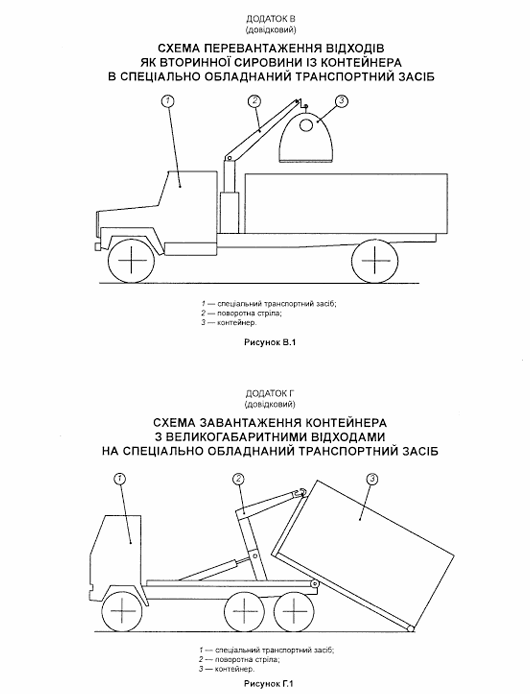
Appendix C Scheme of reloading waste as secondary raw materials from a container into a specially equipped vehicle
Appendix D Scheme of loading a container with bulky waste onto a specially equipped vehicle
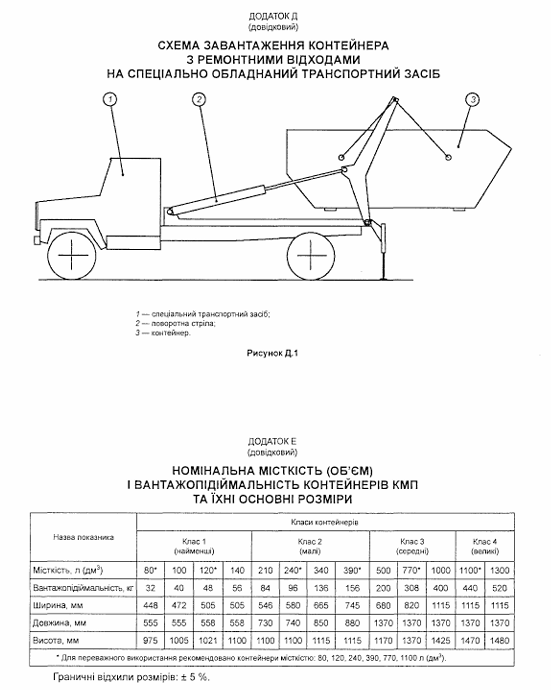
Appendix D Scheme of loading a container with repair waste onto a specially equipped vehicle
Appendix E Nominal capacity (volume) and load capacity of KMP containers and their main dimensions.
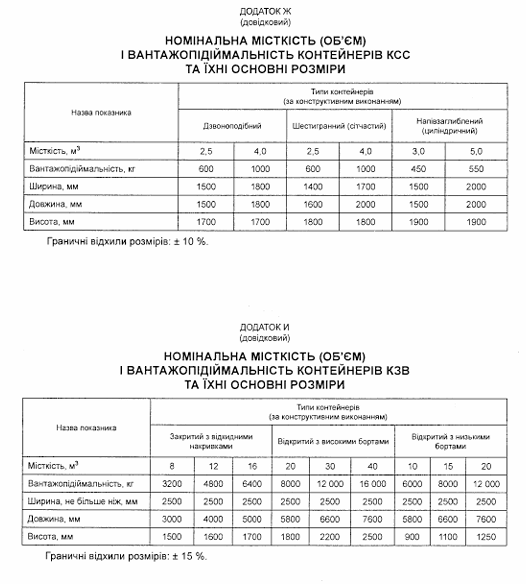
Appendix G Nominal capacity (volume) and load-bearing capacity of KSS containers and their main dimensions
Appendix Y Nominal capacity (volume) and load-bearing capacity of KZV containers and their main dimensions.
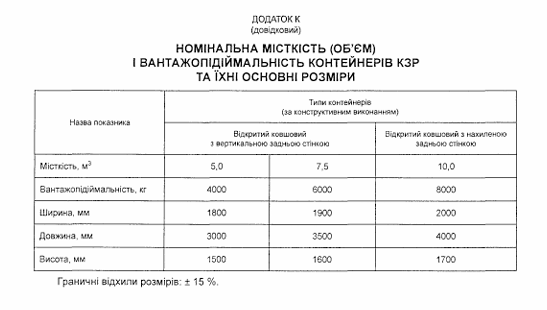
Appendix K Nominal capacity (volume) and load-bearing capacity of KZR containers and their main dimensions
Appendix L Bibliography.
1 SCOPE
Effective from 2017-07-01
1.1 This standard establishes requirements for containers for household waste (solid, large-sized, repair), as well as waste as secondary raw materials.
1.2 This standard applies to containers used for the collection, temporary storage of household waste, as well as waste as secondary raw materials that are among household waste.
1.3 This standard does not apply to containers that were designed, manufactured or imported into Ukraine before the entry into force of this standard and that were and continue to be in operation.
2 REGULATORY REFERENCES
This standard contains references to the following regulatory acts and normative documents:
GOST 9.032-74 ESZKS. Paint and varnish coatings. Groups, technical requirements and designations (ESZKS. Paint and varnish coatings. Groups, technical requirements and designations)
GOST 9.104-79 ESZKS. Paint and varnish coatings. Groups of operating conditions (ESZKS. Paint and varnish coatings. Groups of operating conditions)
GOST 9.307-89 ESZKS. Hot-dip zinc coatings. General requirements and control methods (ESZKS. Hot-dip zinc coatings. General requirements and control methods)
GOST 9.402-80 ESZKS. Paint and varnish coatings. Preparation of metal surfaces before painting (ESZKS. Paint and varnish coatings. Preparation of metal surfaces before painting)
GOST 1759.0-87 Bolts, screws, studs, nuts. Technical conditions (Bolts, screws, studs, nuts. Technical conditions)
GOST 3242-79 Welded joints. Quality control methods (Welded joints. Quality control methods)
GOST 5264-80 Manual arc welding. Welded joints. Main types, structural elements and dimensions (Manual arc welding. Welded joints. Main types, structural elements and dimensions)
GOST 8724-81 Basic interchangeability standards. Metric thread. Diameters and steps
(Basic interchangeability standards. Metric thread. Diameters and steps)
GOST 9142-90 Corrugated cardboard boxes. General technical conditions (Corrugated cardboard boxes. General technical conditions)
GOST 9150-81 Basic interchangeability standards. Metric thread. Profile (Basic interchangeability standards. Metric thread. Profile)
GOST 10354-82 Polyethylene film. Technical conditions (Polyethylene film. Technical conditions)
GOST 12971-67 Rectangular plates for machines and devices. Dimensions (Rectangular plates for machines and devices. Dimensions)
GOST 14771-76 Arc welding in protective gas. Welded joints. Basic types, structural elements and dimensions (Arc welding in shielding gas. Welded joints. Basic types, structural elements, dimensions)
GOST 14776-79 Arc welding. Spot welded joints. Basic types, structural elements and dimensions (Arc welding. Spot welded joints. Basic types, structural elements and dimensions)
GOST 15150-69 Machines, devices and other technical products. Versions for various climatic regions. Categories, conditions of operation, storage and transportation in relation to the influence of climatic factors of the external environment (Machines, devices and other technical products. Versions for different climatic regions. Categories, conditions of operation, storage and transportation in relation to the influence of climatic factors of the external environment)
State sanitary norms and rules for the maintenance of territories of populated areas
DSanPiN 2.2.7.029-99 Hygienic requirements for the management of industrial waste and determination of their hazard class for the health of the population
SanPiN 4630-88 Sanitary rules and norms for the protection of surface waters from pollution (Sanitary rules and norms for the protection of surface waters from pollution).
FROM TERMS AND DEFINITIONS
This standard uses the terms established in the Laws of Ukraine “On Waste” (household waste, solid waste, bulky waste, repair waste, waste collection, waste storage, waste transportation, waste as secondary raw materials
).
The following are additional terms used in this standard and the definitions of the concepts they denote.
3.1 mobile container
A container for household waste, equipped with wheels
3.2 stationary container
A container for household waste, not equipped with wheels
3.3 non-replaceable container
A container for household waste, designed for unloading household waste or waste as secondary raw materials into a specially equipped vehicle directly at the container site
3.4 removable container
A container for household waste, designed for transportation by a specially equipped vehicle to household waste management facilities for the removal of household waste from it
3.5 semi-submerged container
A stationary structure containing a cylindrical or prismatic supporting body (concrete, metal, plastic), into which a replaceable polystyrene insert for solid household waste or waste as secondary raw materials is inserted
3.6 mechanism for lifting and unloading a non-replaceable container
A mechanism mounted on a specially equipped vehicle and intended for lifting a non-replaceable container of the appropriate design and unloading from it household waste or waste as secondary raw materials
3.7 mechanism for loading-unloading a changeable container
A mechanism mounted on a specially equipped vehicle and intended for hooking and loading-unloading a changeable container
3.8 capacity (volume) of the container
Geometric internal volume of the container
3.9 nominal capacity (volume)
The maximum mass of household waste or waste as secondary raw materials in the container during its operation, which is allowed by the manufacturer
3.10 load-bearing capacity of the container
The maximum mass of household waste or waste as secondary raw materials in the container during its operation, which is determined by the manufacturer
3.11 maximum mass of the container with waste
The mass of the container with waste during operation, which determined by the manufacturer.
4 SYMBOLS AND ABBREVIATIONS
CD
— design documentation
ESZKS — unified system of protection against corrosion and aging
KZV
— removable container for large-sized waste
KZR
— removable container for repair waste
KMP — mobile container for household waste and waste as secondary raw materials
KSS — stationary container for waste as secondary raw materials.
5 GENERAL TECHNICAL REQUIREMENTS
5.1 General provisions
5.1.1 Containers are designed and manufactured in accordance with the design documentation (CD) developed for the corresponding type of containers.
5.1.2 CD for the production of containers is developed in accordance with norms, standards and rules.
5.1.3 Types of climatic performance of containers: P — moderate, category 0; PHL — moderate and cold, category 1 — according to GOST 15150.
5.2 Classification of containers
5.2.1 Classification of containers is given in Table 1.
Table 1 — Classification of containers
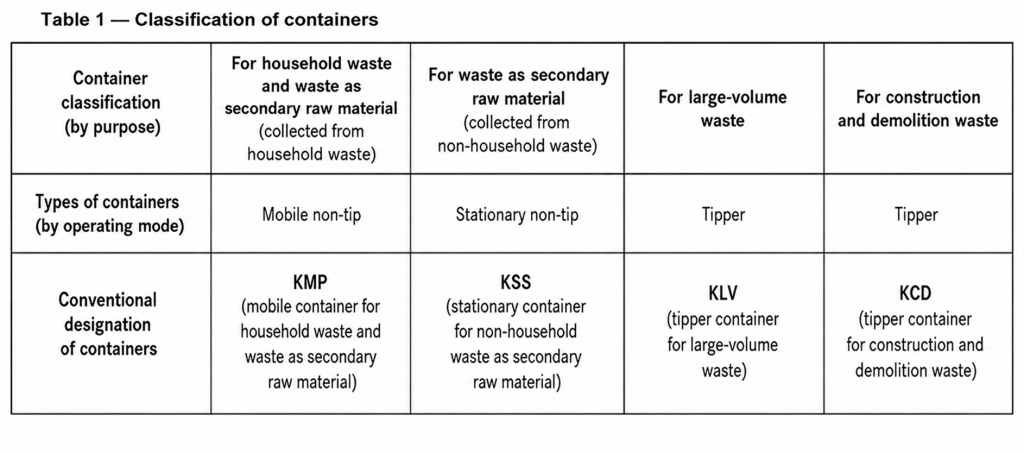
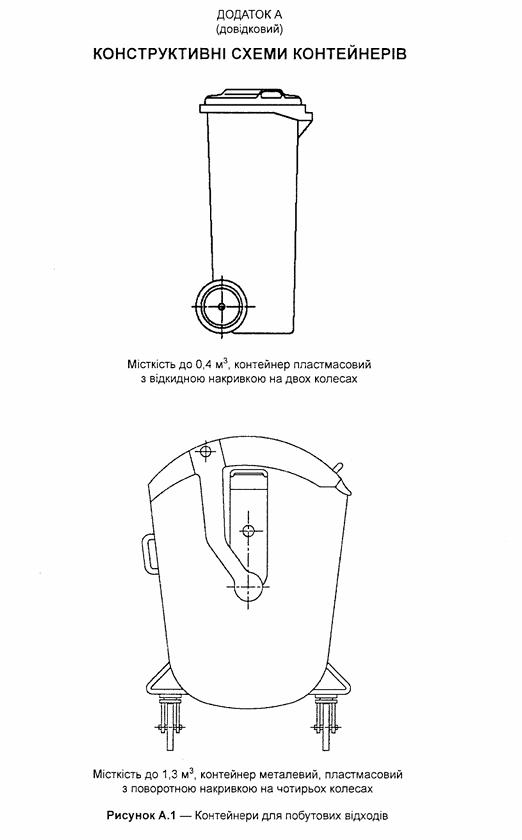
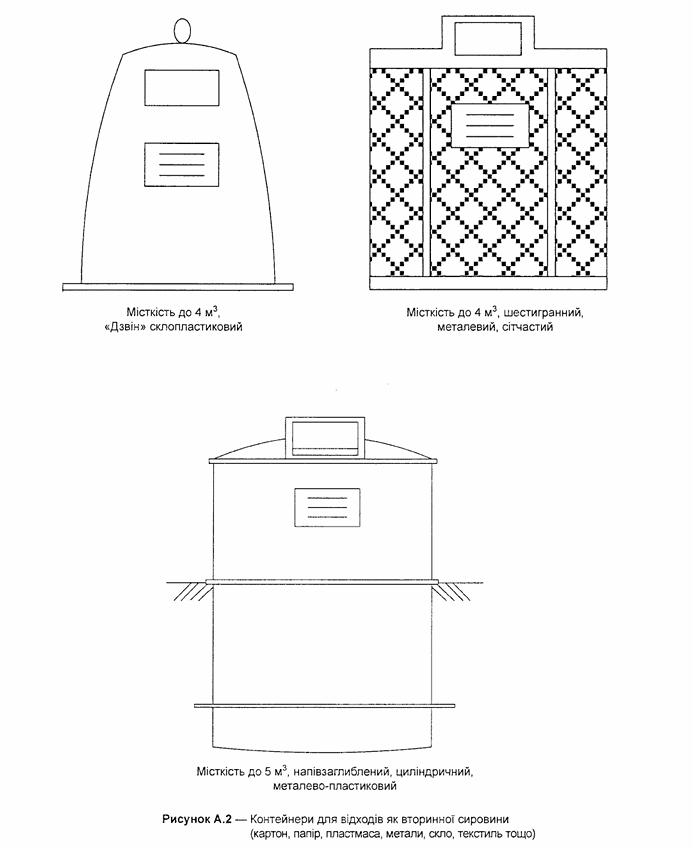
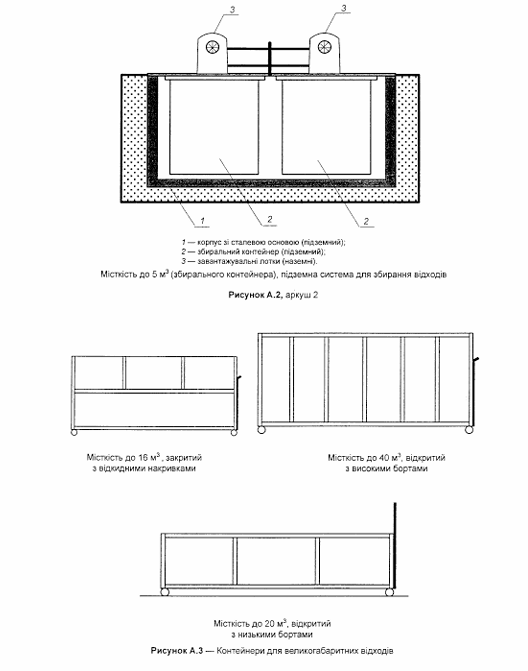
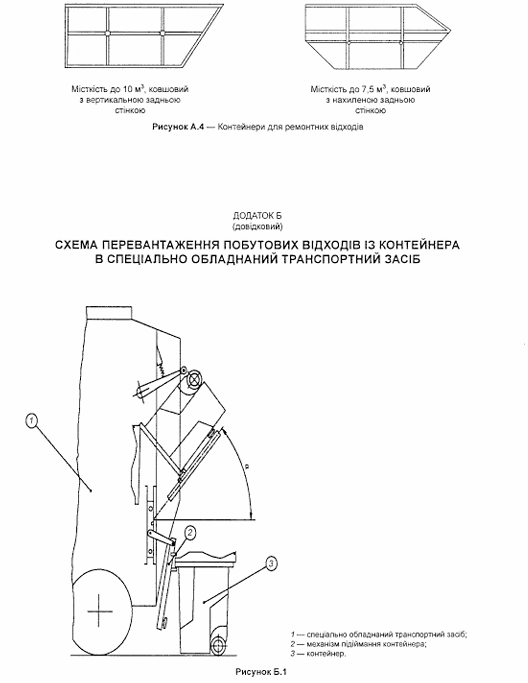
5.2.2. Mobile and stationary non-replaceable containers for solid household waste and/or waste as secondary raw materials (Appendix A) must be adapted for unloading solid household waste or waste as secondary raw materials from them into specially equipped vehicles and be adapted to the mechanism for their lifting (Appendix B and C). In semi-submerged containers, waste as secondary raw materials falls into a special insert, which is removed from the container during unloading, after which the waste from the insert is unloaded into the vehicle, and the insert is inserted back into the container (Appendix A and C). In submerged containers, the collection container itself is lifted,
after which the waste from the container is unloaded into the vehicle, and the container is inserted back into the body (Appendix B).
5.2.3 Containers for large-sized and repair waste (Appendix A) must be adapted for loading and unloading them (empty and with waste) with specially equipped vehicles equipped with a loading mechanism (Appendix G and D).
5.2.4 Waste from KZV containers is unloaded through a self-dumping system, which is equipped with the specially equipped vehicles used.
5.2.5 Containers for repair waste (KZR) (Appendix A) must be adapted for loading them (empty and with waste) onto specially equipped vehicles equipped with a rotating portal boom with slings, and unloading them (empty and with waste) from these specially equipped vehicles (Appendix D).
5.2.6 Waste from KZR containers is unloaded using a rotating portal boom mounted on the special vehicles used.
5.3 Main parameters and dimensions
5.3.1 The main parameters of the containers include: nominal capacity (volume) and load-bearing capacity.
5.3.2 The load-bearing capacity of the container is calculated by the nominal capacity (volume) and maximum density (250 kg/m3 – for waste as secondary raw materials; 400 kg/m3 – for household waste and bulky waste; 800 kg/m3 – for repair waste).
5.3.3 The main dimensions of the containers include: width, length, height.
5.3.4 Mobile containers for household waste or for waste as secondary raw materials (KMP) are divided into 4 classes by nominal capacity (volume):
class 1 — the smallest (nominal capacity up to 200 l);
class 2 — small (nominal capacity from 200 l to 400 l);
class 3 — medium (nominal capacity from 400 l to 1000 l);
class 4 — large (nominal capacity from 1000 l to 1300 l).
5.3.5 Within these classes, mobile containers for household waste and/or for waste as secondary raw materials (KMP), in turn, are divided by nominal capacity (volume).
5.3.6 The capacity (volume) and load-bearing capacity of mobile containers for household waste and/or for waste as secondary raw materials (KMP) by their classes, as well as their main dimensions, are given in Appendix E.
5.3.7 The actual capacity (volume) of a KMP container may not differ by more than (5-10) % from the nominal value.
5.3.8 The capacity (volume) and load-bearing capacity of stationary, unchangeable containers for waste as secondary raw materials (KSS) and their main dimensions are given in Appendix G.
5.3.9 The actual capacity (volume) of a KSS container may not differ by more than (5-10) % from the nominal value.
5.3.10 The capacity (volume) and load-bearing capacity of interchangeable large-sized containers for bulky waste (KZV) and their main dimensions are given in Appendix I.
5.3.11 The actual capacity (volume) of the KZV container may not differ by more than (5-10) % from the nominal value.
5.3.12 The capacity (volume) and load-bearing capacity of interchangeable large-sized containers for repair waste (KZR) and their main dimensions are given in Appendix K.
5.3.13 The actual capacity (volume) of the KZR container may not differ by more than (5-10) % from the nominal value.
5.3.14 The strength and rigidity of the containers must be sufficient to withstand the specified load-bearing capacity.
5.4 Requirements for raw materials
5.4.1 Containers can be made of metal, plastic, fiberglass, and combinations of these and other materials are allowed
5.4.2 The bodies and covers of plastic and fiberglass containers must be solid.
5.4.3 The material of plastic containers is primary or secondary plastic with non-combustible fillers.
5.4.4 Plastic and fiberglass containers must not burn with an open flame in the event of their accidental ignition.
5.4.5 Metal containers are made of sheet and shaped hot-rolled and cold-drawn structural steel of various thicknesses and profiles.
5.4.6 Prefabricated units and parts of containers are bolted or welded in accordance with GOST 8724,
GOST 9150, GOST 1759.0, GOST 5264, GOST 14771, GOST 14776 and GOST 3242.
5.4.7 The protective coating of metal containers can be of the following types:
— paint and varnish — in accordance with GOST 9.032, GOST 9.402 and GOST 9.104;
— galvanic (galvanizing) — in accordance with GOST 9.307;
— polymer
black (coated with polymer compositions with subsequent temperature treatment – sintering).
It is permissible to use other types of protective coatings for container surfaces that are resistant to the conditions of operation of containers outdoors in an aggressive environment of household waste.
5.4.8 Containers for household waste and waste as secondary raw materials (KMP and KSS) must be painted in the following colors:
yellow – for plastic;
green – for glass;
blue – for paper;
cyan – for waste as secondary raw materials;
brown – for organic household waste;
gray – for residual household waste;
red – for hazardous waste as part of household waste (KMP containers).
5.4.9 Containers of the KMP must be installed on two (containers of classes 1 and 2) or four (containers of classes 4 and 5) wheels with the possibility of moving in a horizontal plane.
5.4.10 The wheels are installed with the possibility of:
— turning a two-wheeled container in one place;
— moving a four-wheeled container from a place in any direction or rotating it in one place.
5.4.11 In this case, a two-wheeled container must be moved in an inclined position, in which the center of gravity of the container is in the same vertical plane with the axis of rotation of the wheels.
5.4.12 The wheels of four-wheeled containers of the KMP are equipped with brakes on two wheels with a foot pedal.
5.4.13 On the body of the KMP container on four sides there must be handles for manual movement of the container by loaders.
5.4.14 The designs of KMP containers must ensure their hooking and lifting and reloading of waste into specially equipped vehicles.
5.4.15 KMP containers must have a hinged or rotating lid, hingedly connected to the container body.
5.4.16 It is permissible to adapt the designs of KMP containers for separate collection of household waste and/or waste as secondary raw materials:
— by forming holes in the lid, closed with flexible aprons;
— by forming inspection windows in the side walls, closed with a metal mesh or plexiglass;
— by making the container walls mesh with a rigid welded body and a waterproof lid;
— by applying appropriate inscriptions and plates.
6 SAFETY REQUIREMENTS
6.1 The design of containers must prevent injury to consumers.
6.2 Containers must be resistant to accidental tipping.
6.3 During the operation of containers, it is not permissible:
— to be in the area of the lifting mechanism of a specially equipped vehicle during lifting and reloading of the container;
— to hold the container with your hands and assist the lifting mechanism after the container is engaged with the lifting mechanism of a specially equipped vehicle;
— to hold the KMP container by the rear handles when opening the rotating lid of the container;
— to be in the area of the hinged or rotating lid of the container during its opening;
— to contact plastic containers with open fire.
7 ENVIRONMENTAL PROTECTION REQUIREMENTS
7.1 The materials from which the containers are made must be non-toxic and not cause a negative impact on the environment and human health.
7.2 The materials from which the containers are made must not stimulate the development of microflora, must be resistant to disinfectants and temperature changes in the air environment and the aggressive environment of household waste.
7.3 During the operation of containers, surface waters are protected in accordance with SanPiN 4630.
7.4 During the operation of containers, soil is protected in accordance with the State Sanitary Norms and Rules for the Maintenance of Territories of Settlements.
7.5 3 waste during the operation of containers is handled in accordance with DSanPiN 2.2.7.029.
8 MARKING, PACKAGING AND TRANSPORTATION
8.1 Containers are marked by the impact method on a plate in accordance with GOST 12971.
8.2 The plate must contain the following information:
— name of the manufacturing enterprise and its trademark;
— container mark;
— date of manufacture;
— total permissible mass;
— serial number of the container (according to the manufacturer’s numbering system).
The total permissible mass of the container must be no less than the sum of the doubled load capacity plus the mass of the container.
8.3 Containers are sold assembled or with dismantled covers and wheels in accordance with the terms of the contract.
8.4 KMP containers are packed in polyethylene film manufactured in accordance with GOST 10354.
8.5 KMP containers packed in polyethylene film are placed in corrugated boxes in accordance with GOST 9142.
Packing in wooden and other boxes with sufficient strength to guarantee the integrity of the containers during transportation is allowed.
8.6 KSS, KZV, KZR containers can be sold without packaging.
8.7 Operational and accompanying documentation is placed in a plastic film bag. Plastic film is in accordance with GOST 10354.
8.8 Containers for sale are transported by all modes of transport, observing the rules applicable to this type of transportation.