

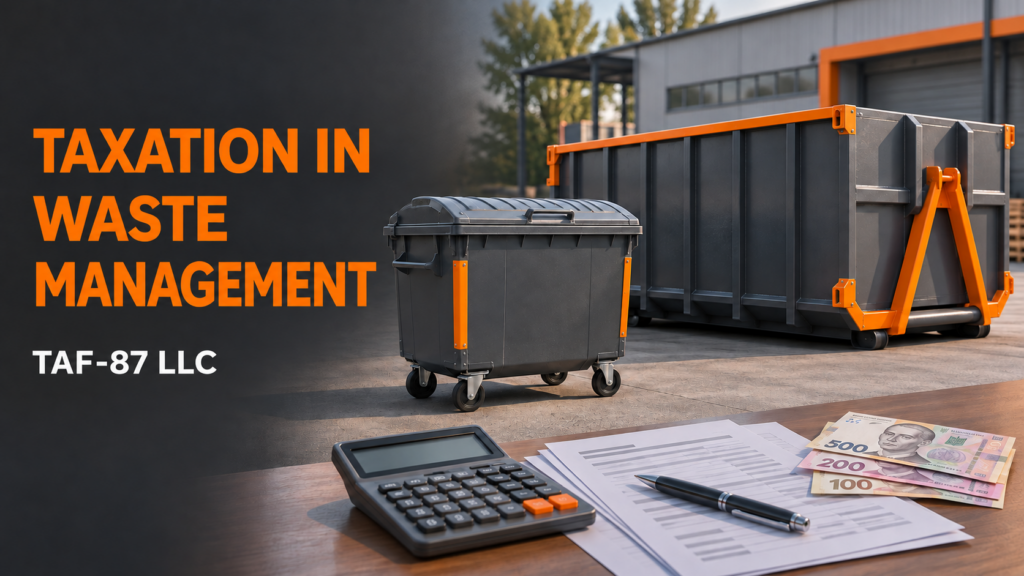
Taxation in Waste Management: What Businesses Need to Know
Waste management at a business involves more than installing containers and arranging regular waste collection. It also requires accurate accounting records. To determine their tax obligations, businesses need to consider the type of waste, how it is managed, the arrangements for transferring it to contractors, and their tax regime.
This article explains Ukraine’s environmental tax on waste disposal, VAT considerations, and the documents that help businesses maintain organised records.
Information checked as of 9 November 2026. This article provides general information about Ukrainian legislation. Its application to a particular business depends on that business’s circumstances.
Who Pays Environmental Tax on Waste?
The Tax Code of Ukraine identifies entities carrying out waste disposal as environmental taxpayers. An exception applies to certain types of waste held as secondary raw materials on a business’s own premises or sites.
For tax purposes, the Ukrainian legal term for “waste placement” refers to the permanent or final deposit or burial of waste at designated locations or facilities. Businesses therefore need to assess their actual waste management activities rather than simply whether they have waste bins on their premises.
Temporary Storage: Why Current Tax Guidance Matters
The temporary accumulation of waste before it is transferred to a contractor requires particular attention. Earlier guidance from the State Tax Service of Ukraine stated that no environmental tax was payable where a waste transfer agreement was in place. However, the relevant answer in its public information database is marked as having applied only until 6 May 2024.
The current guidance takes a broader approach: temporary placement of waste, including hazardous waste, that does not qualify as certain types of secondary raw materials gives rise to environmental tax obligations.
A waste collection agreement should therefore not be treated as an unconditional guarantee that no environmental tax is due. Given the difference between the statutory definition of waste placement and the broad interpretation of temporary accumulation in the tax authority’s guidance, businesses should review their circumstances with an accountant or tax adviser and, where necessary, request an individual tax ruling.
How Is Environmental Tax Calculated?
Environmental tax is calculated using the actual quantity of waste disposed of, the applicable rates, and adjustment coefficients. Relevant factors include:
- The type and hazard class of the waste.
- The actual quantity disposed of.
- The location of the disposal facility.
- The conditions under which the waste is disposed of.
Article 246 of the Tax Code establishes rates per tonne of waste. For certain categories, including fluorescent lamps, rates apply per item. Where no hazard class has been established, the rate for Class I waste applies.
Container volume should not be confused with waste weight. For example, an 8 m³ skip can hold materials with very different densities. Businesses should use weighing results and properly prepared supporting documents for their records rather than relying solely on container capacity.
When Must Returns Be Filed and Tax Paid?
The standard reporting period for environmental tax is a calendar quarter. Under the general rules:
- The tax return must be filed within 40 calendar days after the end of the quarter.
- The tax must be paid within 10 calendar days after the filing deadline.
Returns are prepared separately for each quarter rather than on a cumulative year-to-date basis. Businesses should check the tax calendar for specific deadlines, taking account of deadline adjustment rules and any applicable special provisions.
VAT on Sales of Waste and Secondary Raw Materials
Selling secondary raw materials does not automatically qualify for a VAT exemption. Where the seller is a VAT-registered taxpayer and no specific exemption applies, the general VAT rules apply, including the standard rate of 20%.
However, until 1 January 2027, a VAT exemption applies to supplies of specified ferrous and non-ferrous metal waste and scrap, as well as paper and paperboard for recycling classified under heading 4707 of Ukraine’s commodity classification, UKT ZED. For metal scrap, businesses must check whether the material falls within the lists approved by the Cabinet of Ministers of Ukraine. This exemption must not be automatically extended to plastic, glass, or other waste.
A VAT exemption does not eliminate all related accounting obligations. Depending on how goods, services, and assets purchased with VAT are used, additional VAT liabilities or adjustments may arise under Articles 198 and 199 of the Tax Code.
Corporate Income Tax and Waste Management Expenses
For corporate income taxpayers, taxable profit is based on the accounting financial result, adjusted as required by the Tax Code.
Revenue from sales of secondary raw materials and expenses for related services are recognised according to the nature of each transaction. Environmental tax and corporate income tax have different tax bases and must be calculated separately.
Which Documents Should Businesses Keep?
To monitor waste-related transactions, businesses should maintain:
- Agreements with companies that receive or transport waste.
- Waste handover and acceptance documents, together with records of services provided.
- Delivery notes, weighing records, and documents supporting sales of secondary raw materials.
- Records identifying waste types, quantities, and classifications.
- Documents confirming contractors’ required permits and licences.
- VAT invoices and tax calculations where applicable.
A practical accounting system should make it possible to trace each waste stream from generation and accumulation through to its transfer to another business.
Containers for Organised Waste Collection
Separate, clearly labelled containers help businesses segregate waste streams, monitor fill levels, and plan collections. The appropriate container depends on the materials being collected, their quantity, and the loading method.
TAF-87 LLC manufactures 0.75 m³ metal waste bins, 8.0 m³ skips, hooklift containers with capacities of up to 42.0 m³, and waste compactors. The company designs and manufactures equipment to meet customers’ requirements.
Explore equipment for waste collection, storage, and transportation at baki87.com.ua.